Executive Summary / Quick Takeaway
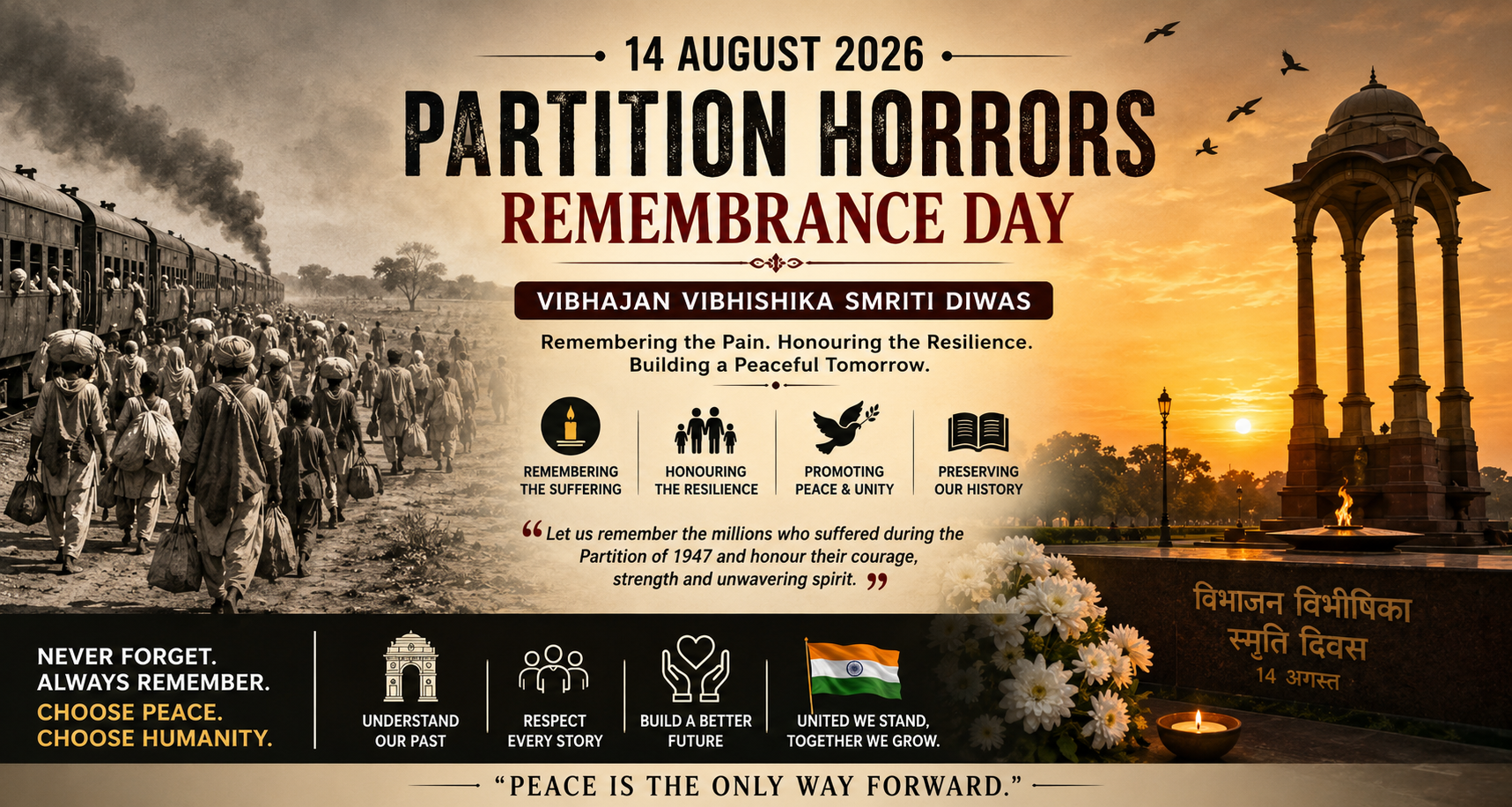
14 August is observed in India as Partition Horrors Remembrance Day, remembering the suffering, sacrifices and displacement caused by the Partition of 1947. Explore its history, significance and important places connected with India's Partition story.
14 August 2026: Partition Horrors Remembrance Day
Every year, 14 August is observed in India as Partition Horrors Remembrance Day, also known as Vibhajan Vibhishika Smriti Diwas.
The day remembers the people who lost their lives, homes and livelihoods during the Partition of 1947 and honours the resilience of those who were forced to rebuild their lives after displacement. The Government of India announced the annual observance in 2021.
While 15 August is celebrated as India's Independence Day, 14 August provides an opportunity to remember the difficult human cost that accompanied Partition and to reflect on the importance of peace, unity and social harmony.
What Happened on 14 August 1947?
The year 1947 marked a major turning point in the history of the Indian subcontinent.
British rule came to an end and the subcontinent was divided into two new dominions, India and Pakistan.
Partition resulted in one of the largest episodes of forced migration in modern history. Millions of people crossed newly created borders, leaving behind homes, communities, businesses and ancestral lands.
The Government of India has described Partition as a period that caused immense displacement, violence and suffering.
Why is 14 August Observed as Partition Horrors Remembrance Day?
In 2021, the Government of India announced that 14 August would be observed every year as Partition Horrors Remembrance Day.
The purpose is to remember those who suffered during Partition and to ensure that future generations understand the human impact of the events of 1947.
The observance also emphasises the importance of:
- Peace
- Unity
- Social harmony
- Human dignity
- Compassion
- Remembering history
The Human Cost of Partition
Partition was not simply a political event.
For millions of ordinary people, it meant leaving their homes and starting life again in unfamiliar places.
Families were separated, communities were disrupted and countless people experienced violence, uncertainty and displacement.
Government sources describe the Partition migration as affecting approximately 20 million people, making it one of the largest migrations in human history.
The exact number of deaths remains debated by historians, but there is broad agreement that the violence and displacement caused enormous human suffering.
Stories of Resilience
Although Partition brought immense suffering, it also revealed the extraordinary resilience of ordinary people.
Many refugees arrived with very little but gradually rebuilt their:
- Homes
- Businesses
- Careers
- Communities
- Families
Over the following decades, many displaced families made significant contributions to India's social, economic and cultural development.
The 2025 government observance specifically highlighted the grit and resilience of people affected by Partition and their ability to rebuild their lives after enormous loss.
Important Places Connected With Partition History
For travellers interested in history, several places across India help preserve memories and stories connected with Partition.
1. Partition Museum – Amritsar
The Partition Museum in Amritsar is one of the most important places for understanding the human stories of Partition.
It preserves:
- Personal stories
- Photographs
- Documents
- Memories
- Oral histories
- Objects associated with displaced families
A visit can help travellers understand Partition through the experiences of ordinary people rather than only through political history.
2. Jallianwala Bagh – Amritsar
Jallianwala Bagh is associated with the freedom struggle and the events of 13 April 1919.
Although it predates Partition, the memorial is an important part of India's broader freedom-history journey.
A historical Amritsar itinerary can combine:
Golden Temple → Jallianwala Bagh → Partition Museum
This gives visitors an opportunity to understand different chapters of Punjab and India's modern history.
3. Attari Border – Punjab
The Attari border near Amritsar is one of the most recognisable India-Pakistan border locations.
The border represents the geographical division created during Partition while also becoming a popular destination for visitors interested in India's border history.
Travellers should check current security and visitor arrangements before planning a visit.
4. Delhi
Delhi played a major role during the period surrounding Independence and Partition.
The city became a destination for many displaced families who arrived from areas that became part of Pakistan.
Visitors interested in this history can explore Delhi's:
- Old Delhi
- Red Fort
- National Archives area
- Museums
- Historic neighbourhoods
Delhi's heritage provides a broader context for understanding India's transition to independence.
5. Kolkata
Kolkata is another important city for understanding the history of Partition.
The division of Bengal had a major impact on eastern India, and migration continued for years after 1947.
Travellers interested in this history can explore Kolkata's museums, heritage neighbourhoods and historical institutions.
6. Punjab
Punjab was among the regions most deeply affected by the Partition of 1947.
The division of Punjab resulted in enormous migration and disruption.
Today, places across Punjab preserve memories of the communities and families affected by those events.
For history lovers, a Punjab heritage journey can provide valuable insight into this chapter of India's past.
Why Should Young People Learn About Partition?
History becomes meaningful when it helps future generations understand the consequences of major events.
Learning about Partition can help young people understand:
- The value of peace
- The importance of social harmony
- The consequences of hatred and violence
- The importance of preserving memories
- The strength of human resilience
Remembering difficult history does not mean living in the past. It can help society learn from the past and build a more peaceful future.
14 August and 15 August: Why Both Days Matter
The two dates are closely connected to India's history but represent different aspects of the 1947 transition.
14 August
Partition Horrors Remembrance Day
A day to remember the suffering, displacement and sacrifices associated with Partition.
15 August
Independence Day
India's national celebration of independence from British rule.
Together, the two days provide an opportunity to remember both the joy of independence and the human cost associated with Partition.
How Can We Observe 14 August?
Partition Horrors Remembrance Day can be observed respectfully through learning and remembrance.
Visit a Museum
Visit places such as the Partition Museum in Amritsar.
Listen to Oral Histories
Personal stories can provide a deeper understanding of what families experienced.
Read About Partition
Books, documentaries and historical archives can help develop a better understanding of 1947.
Visit Historical Places
Exploring historical sites can make the country's past more tangible.
Talk to Older Generations
Family memories and stories can help preserve personal histories that might otherwise disappear.
Travel and History: Learning Through Journeys
Travel is not only about beaches, mountains and sightseeing.
Historical travel allows us to understand the people and events that shaped a place.
A journey through Amritsar, Delhi, Punjab or Kolkata can become an educational experience when travellers take time to explore museums, memorials and historical neighbourhoods.
TravelOChat encourages travellers to explore destinations with curiosity and respect.
Suggested Historical Travel Itinerary
Day 1 – Amritsar
Visit:
- Golden Temple
- Jallianwala Bagh
- Partition Museum
Spend the evening exploring Amritsar's heritage streets.
Day 2 – Border & Heritage
Visit:
- Attari-Wagah Border
- Local heritage attractions
- Amritsar markets
Return to the city in the evening.
Day 3 – History & Culture
Explore additional museums and cultural attractions before departing Amritsar.
This itinerary can be customised according to travel time and current visitor arrangements.
Travel Tips for Historical Places
If you are visiting Partition-related heritage sites:
- Maintain a respectful attitude.
- Read information displayed at museums and memorials.
- Avoid making insensitive jokes or comments.
- Follow photography rules.
- Do not touch historical objects.
- Respect personal stories shared by survivors and families.
- Check current opening hours before travelling.
- Allow enough time for museums and memorials.
Why Remembering History Matters
A country cannot understand its present without understanding its past.
Remembering Partition helps us recognise the importance of:
Unity – Communities can live together despite differences.
Peace – Violence can cause consequences that continue across generations.
Humanity – Historical events are ultimately experienced by ordinary people.
Resilience – People can rebuild even after enormous hardship.
Memory – Preserving stories helps future generations learn from history.
TravelOChat's Message on 14 August
At TravelOChat, we believe travel is also a way of learning.
India's destinations are filled with stories of courage, struggle, culture and resilience.
This 14 August, take a moment to learn about the history behind the places you visit.
Visit a museum, explore a heritage site, listen to a historical story and remember the people whose lives were changed by Partition.
Remember the past. Respect the stories. Build a peaceful future.
Final Words
14 August is a day of remembrance.
Partition changed the lives of millions of people and left a lasting mark on the history of India and the subcontinent.
Partition Horrors Remembrance Day provides an opportunity to remember those who suffered, honour their resilience and understand why peace, unity and social harmony remain important.
As India moves towards another Independence Day, remembering the difficult chapters of history can make the celebration of freedom more meaningful.
Written by TraveloChat Editorial
Senior Destination Specialist at TraveloChat Desk. Expert in itinerary planning, B2B hotel contracts, and international visa concierge.Inspired to Visit Domestic Destinations?
Get a 100% customized tour package with direct B2B transparent pricing and 24/7 on-tour support.