
Executive Summary / Quick Takeaway
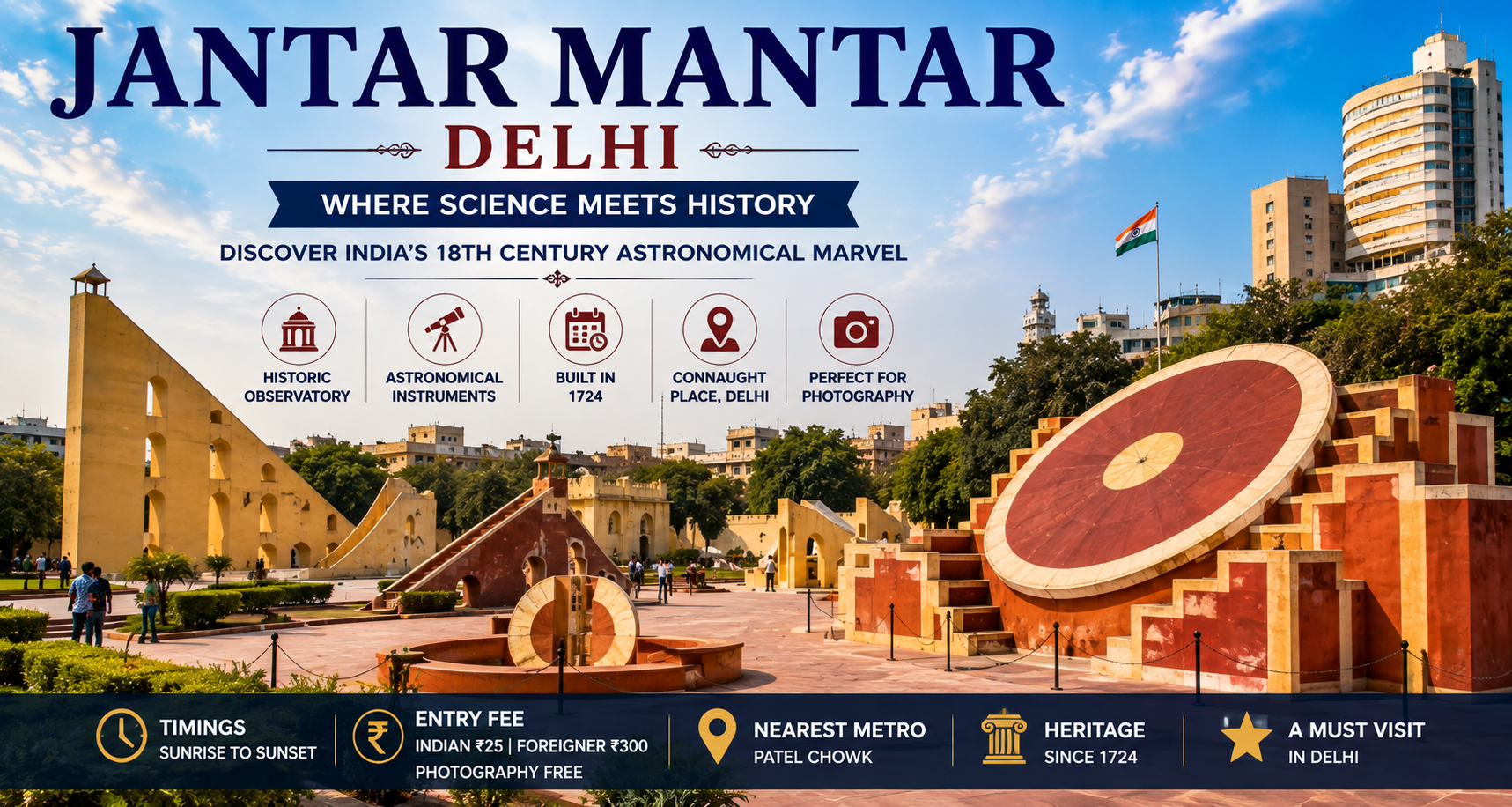
Discover Jantar Mantar Delhi, the historic astronomical observatory built by Maharaja Jai Singh II in 1724. Explore its unique instruments, fascinating history, location, timings, nearby attractions and useful travel tips with this complete TravelOChat guide.
Jantar Mantar Delhi Travel Guide 2026
Delhi is famous for its historic forts, monuments and museums, but hidden among the busy streets of Connaught Place is a fascinating monument dedicated to astronomy and scientific observation — Jantar Mantar.
Built in 1724 by Maharaja Jai Singh II of Jaipur, Jantar Mantar is a historic astronomical observatory containing large-scale instruments designed to study the movement and position of celestial objects. Delhi Tourism notes that Jai Singh built similar observatories at Ujjain, Varanasi and Mathura as well.
Today, Jantar Mantar offers visitors a chance to see how astronomy was studied before modern telescopes and electronic instruments.
What is Jantar Mantar?
The name Jantar Mantar is derived from words associated with instruments and calculation/formulae. The Delhi observatory was designed as a collection of large astronomical instruments that could be used to make observations related to the Sun, stars and celestial positions.
Instead of using small portable instruments, Maharaja Jai Singh commissioned large masonry structures. Their size helped improve the precision of astronomical observations compared with smaller instruments available at the time.
The site is therefore an interesting combination of:
- Science
- Astronomy
- Architecture
- History
- Mathematics
- Heritage
History of Jantar Mantar Delhi
Jantar Mantar Delhi was constructed in 1724 under Maharaja Jai Singh II of Jaipur.
Jai Singh was deeply interested in astronomy and mathematical calculations. He believed that larger instruments could provide more accurate observations than the smaller instruments being used at the time.
He subsequently established similar observatories in other cities, including Jaipur, Ujjain, Varanasi and Mathura.
The Delhi observatory is therefore part of a larger scientific and architectural legacy created during the 18th century.
Why is Jantar Mantar Important?
Jantar Mantar is important because it shows how astronomers used large architectural instruments to study the sky before the widespread use of modern telescopes.
The structures were carefully designed according to astronomical principles.
The observatory demonstrates how architecture, geometry and astronomy could be combined to create practical scientific instruments.
UNESCO documentation on India's Jantar Mantar observatories describes these sites as important examples of pre-telescopic masonry astronomical instruments.
Major Instruments at Jantar Mantar
The observatory contains several fascinating instruments, each designed for particular astronomical observations.
Samrat Yantra
The Samrat Yantra is a giant sundial-like instrument designed to measure astronomical time and celestial positions.
Its massive triangular structure and curved scales demonstrate the impressive scale of 18th-century astronomical engineering.
Jai Prakash Yantra
The Jai Prakash Yantra consists of large hemispherical structures.
These instruments were designed to represent the celestial sphere and help determine the position of celestial objects.
The instrument is particularly interesting because visitors can walk around and observe its large-scale astronomical markings.
Ram Yantra
The Ram Yantra consists of cylindrical structures with a central pillar.
It was designed for measuring the altitude and azimuth of celestial objects.
Its open design makes it one of the most visually interesting instruments at the observatory.
Mishra Yantra
Mishra Yantra is another important group of structures at the observatory.
The different components were designed for astronomical calculations and observations involving celestial bodies.
Digamsa Yantra
The Digamsa Yantra is associated with measuring angular distances in relation to the north direction.
It demonstrates how the instruments at Jantar Mantar were designed for specific astronomical calculations.
How Did Jantar Mantar Work?
The instruments at Jantar Mantar used basic principles of:
- Geometry
- Shadows
- Angles
- Earth's rotation
- Celestial coordinates
- Solar movement
For example, the position of a shadow could be observed against carefully marked scales to determine time or celestial measurements.
Large structures provided a way to make measurements with greater precision than smaller instruments.
UNESCO documentation describes instruments such as Ram Yantra, Samrat Yantra and Jai Prakash Yantra as part of India's historic tradition of large-scale, pre-telescopic astronomical observation.
Jantar Mantar Location
Jantar Mantar is located on Parliament Street near Connaught Place in New Delhi.
Nearest Metro Station
Patel Chowk Metro Station is the metro station listed by Delhi Tourism for Jantar Mantar.
Its central location makes it easy to combine with several other Delhi attractions.
Jantar Mantar Timings
According to the current Delhi Tourism listing, Jantar Mantar is:
Open: All days
Timings: Sunrise to Sunset
Timings and visitor arrangements can change, so it is advisable to check the latest official information before visiting.
Jantar Mantar Entry Fee
Delhi Tourism currently lists:
- Indian visitors: ₹25
- Foreign visitors: ₹300
- Photography: No charge
- Video filming: ₹25
These charges are subject to change, so visitors should verify the current fee before travelling.
Best Time to Visit Jantar Mantar
October to March
Winter and early spring are generally comfortable for outdoor sightseeing in Delhi.
The cooler weather makes it easier to spend time exploring the large astronomical structures.
April to June
Delhi can become very hot during summer.
If visiting during these months, early morning is a better choice for outdoor sightseeing.
July to September
The monsoon season can bring rain and humidity.
Check the weather forecast before planning your visit.
Best Time of Day
Morning and late afternoon are generally comfortable times for exploring the open-air observatory.
Things to Do at Jantar Mantar
Explore the Astronomical Instruments
Take your time to walk around the different structures and understand their purpose.
Learn About Ancient Astronomy
Jantar Mantar provides an excellent opportunity to understand how astronomical observations were conducted before modern technology.
Photography
The geometric shapes, giant scales and unusual structures make Jantar Mantar an interesting photography location.
Combine It With Connaught Place
After visiting the observatory, explore nearby Connaught Place for shopping, cafés, restaurants and local experiences.
Visit Nearby Heritage Sites
Jantar Mantar can easily be included in a full-day Delhi sightseeing itinerary.
Places to Visit Near Jantar Mantar
Connaught Place
Located close to Jantar Mantar, Connaught Place is one of Delhi's most famous commercial and entertainment areas.
Visitors can enjoy:
- Shopping
- Restaurants
- Cafés
- Street food
- Bookstores
- Local markets
India Gate
India Gate is one of Delhi's most recognised landmarks and can be combined with Jantar Mantar in a city sightseeing itinerary.
Gurudwara Bangla Sahib
This beautiful Sikh shrine is another popular attraction in central Delhi.
It is known for its peaceful atmosphere and community service.
Agrasen Ki Baoli
This historic stepwell is located not far from Jantar Mantar and is an interesting addition to a heritage-focused Delhi itinerary.
Delhi Tourism specifically suggests combining Jantar Mantar with Agrasen Ki Baoli and nearby attractions during its Delhi itinerary.
Rashtrapati Bhavan
The area around central Delhi also provides opportunities to see important government and colonial-era architecture.
Suggested One-Day Delhi Itinerary
Morning
Start your day with:
Jantar Mantar → Connaught Place
Spend time exploring the astronomical instruments before heading towards Connaught Place.
Afternoon
Continue towards:
India Gate → Rashtrapati Bhavan area
Enjoy Delhi's central heritage and architecture.
Evening
End your day with:
Gurudwara Bangla Sahib → Connaught Place
Enjoy dinner or explore the cafés and markets around Connaught Place.
How to Reach Jantar Mantar
By Metro
The easiest option for many travellers is Delhi Metro.
Nearest Metro Station: Patel Chowk.
From there, Jantar Mantar is accessible by a short walk or local transport.
By Road
Visitors can reach Jantar Mantar by:
- Taxi
- Cab
- Auto-rickshaw
- Private car
- Tourist bus
Because it is in central Delhi, traffic can be heavy during peak hours.
Travel Tips for Jantar Mantar
Before visiting, keep these tips in mind:
- Wear comfortable walking shoes.
- Carry drinking water, especially during summer.
- Visit early morning during hot weather.
- Follow site rules.
- Do not climb restricted structures.
- Keep the monument clean.
- Carry sunscreen and sunglasses during summer.
- Take enough time to understand the instruments.
- Check current entry fees before visiting.
- Combine the visit with nearby Delhi attractions.
Is Jantar Mantar Good for Families?
Yes. Jantar Mantar can be an interesting destination for families, especially for children interested in:
- Science
- Astronomy
- Mathematics
- History
- Architecture
The large instruments can make abstract astronomical concepts easier to understand visually.
Is Jantar Mantar Good for Students?
Absolutely.
Students can learn about the practical application of:
- Geometry
- Trigonometry
- Astronomy
- Time measurement
- Celestial coordinates
- Scientific observation
A visit can be especially useful when combined with an educational Delhi heritage tour.
Is Jantar Mantar Good for Photography?
Yes.
The large geometric structures, curves, stairways and astronomical markings create unique photographic compositions.
Early morning and late afternoon light can be particularly attractive for photography.
Visitors should follow the site's photography rules and avoid restricted areas.
Why Visit Jantar Mantar with TravelOChat?
Delhi has countless famous monuments, but Jantar Mantar offers a different kind of experience.
It allows travellers to explore the scientific and astronomical heritage of 18th-century India while also enjoying the attractions of central Delhi.
With TravelOChat, travellers can include Jantar Mantar in:
- Delhi sightseeing tours
- Family holidays
- Educational trips
- Heritage tours
- Weekend Delhi trips
- North India tour packages
A well-planned itinerary can combine Jantar Mantar with Connaught Place, India Gate, Gurudwara Bangla Sahib, Agrasen Ki Baoli and other major attractions.
Final Words
Jantar Mantar Delhi is a fascinating reminder of India's historic scientific knowledge.
Built in 1724 under Maharaja Jai Singh II, the observatory transformed astronomical calculations into impressive architectural structures.
Today, visitors can walk among these giant instruments and discover how astronomers once studied the Sun, stars and celestial movements without modern telescopes or digital technology.
If you are exploring Delhi and want to experience something beyond the usual forts and monuments, Jantar Mantar is definitely worth adding to your itinerary.
Plan your Delhi trip with TravelOChat and discover the history, science and heritage of Jantar Mantar.
Related Tags:
Written by TraveloChat Editorial
Senior Destination Specialist at TraveloChat Desk. Expert in itinerary planning, B2B hotel contracts, and international visa concierge.Inspired to Visit Delhi, Domestic Destinations, Travel, Travel Tips & Hacks, TravelOChat, Trip Ideas, Visa Guidance?
Get a 100% customized tour package with direct B2B transparent pricing and 24/7 on-tour support.