Executive Summary / Quick Takeaway
Discover the divine significance of Lord Shiva, one of the principal deities of Hinduism. Explore Shiva's mythology, symbols, Jyotirlingas, famous Shiva temples in India, Maha Shivratri and spiritual destinations associated with Mahadev.
Lord Shiva: History, Significance, Jyotirlingas & Famous Shiva Temples in India
India is a land of spirituality, ancient traditions and magnificent temples. Among the most revered deities in Hinduism is Lord Shiva, also lovingly known as Mahadev, Bholenath, Shankar and Neelkanth.
For millions of devotees, Lord Shiva represents strength, meditation, transformation and spiritual consciousness. From the snow-covered Himalayas to ancient temples across India, the presence of Shiva can be experienced in countless sacred destinations.
A journey to famous Shiva temples is therefore not only a travel experience but can also be a deeply spiritual and cultural experience.
Who is Lord Shiva?
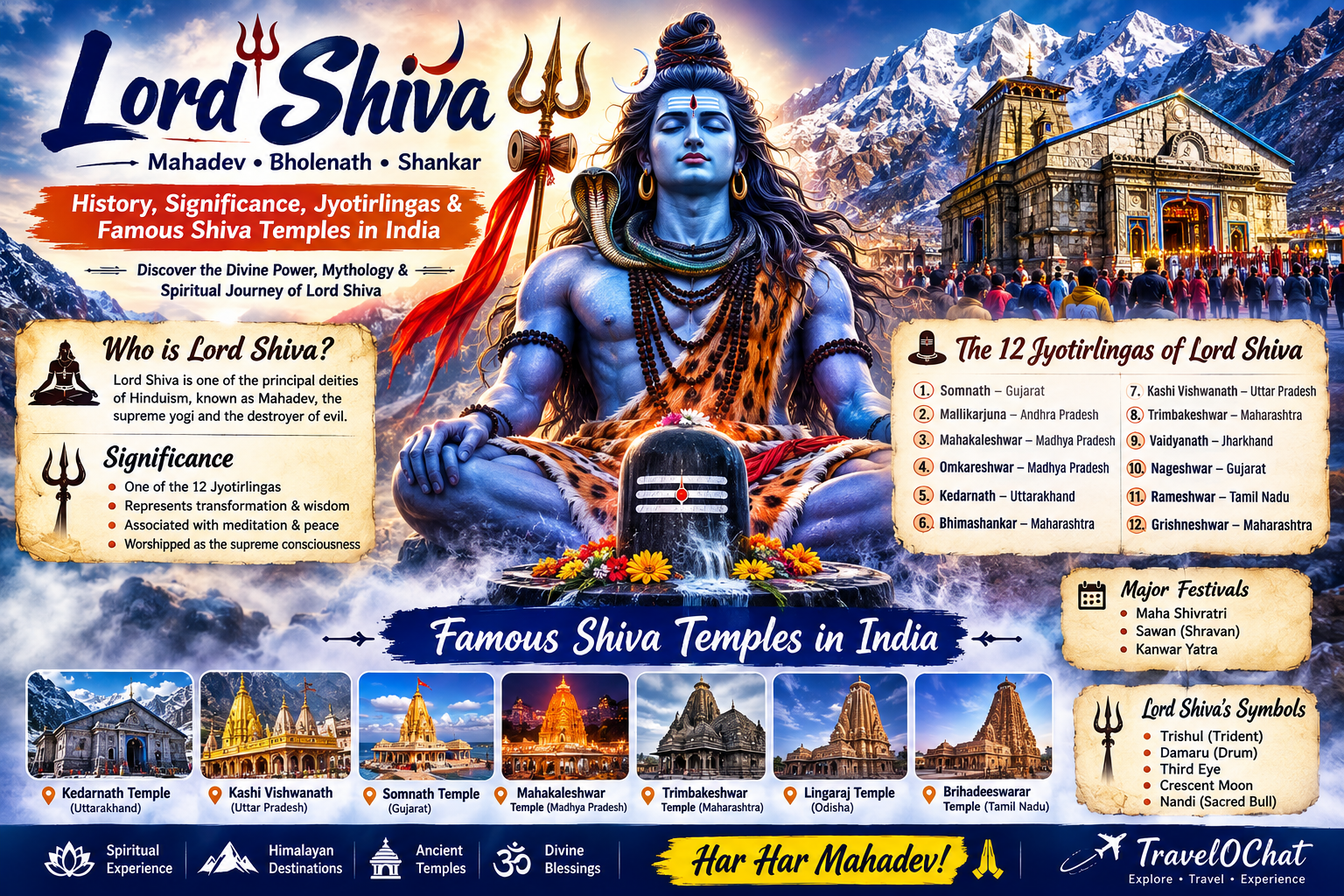
Lord Shiva is one of the principal deities of Hinduism and is traditionally associated with the cosmic functions of destruction and transformation.
He is commonly represented as part of the Trimurti, alongside Brahma and Vishnu.
- Brahma – associated with creation
- Vishnu – associated with preservation
- Shiva – associated with transformation and dissolution
Shiva is also regarded as the supreme yogi and is closely connected with meditation, asceticism and spiritual knowledge.
Why is Lord Shiva Called Mahadev?
The word Mahadev means "Great God".
Devotees use this name to express their deep reverence for Lord Shiva.
Shiva is worshipped in many different forms and traditions across India. His worship is particularly associated with the Shivling, an important symbol representing Shiva.
The Story and Mythology of Lord Shiva
Lord Shiva appears in numerous stories and traditions found in Hindu scriptures and religious literature.
He is associated with:
- Mount Kailash
- Goddess Parvati
- Lord Ganesha
- Lord Kartikeya
- Nandi
- The Ganga
- The third eye
- The trident
- The damaru
- Meditation and yoga
These stories have been passed down through generations and continue to influence Indian art, culture and temple traditions.
Lord Shiva and Goddess Parvati
One of the most important relationships in Hindu mythology is that of Lord Shiva and Goddess Parvati.
Their story represents devotion, partnership and divine balance.
Parvati is traditionally described as the daughter of the Himalayas and the reincarnation of Sati.
According to Hindu traditions, Parvati undertook intense penance to win Shiva's acceptance, eventually becoming his consort.
Together, Shiva and Parvati are associated with family, balance and divine energy.
Lord Shiva and Mount Kailash
Mount Kailash holds an extremely important place in traditions associated with Lord Shiva.
It is traditionally regarded as the abode of Lord Shiva and Goddess Parvati.
Located in the Tibetan Himalayas, Mount Kailash is considered sacred by followers of Hinduism as well as several other religious traditions.
The mountain's remote location and spectacular landscape have made it one of the world's most famous pilgrimage destinations.
The Symbolism of Lord Shiva
Lord Shiva is represented through many powerful symbols.
The Trishul
The Trishul, or trident, is one of Shiva's most recognisable symbols.
It is traditionally interpreted in several ways, including associations with the three fundamental qualities or aspects of existence.
The Damaru
The Damaru is a small traditional drum associated with Shiva.
It is often connected with cosmic sound and creation.
The Third Eye
Shiva's third eye is a powerful symbol of spiritual knowledge and transformation.
In Hindu mythology, opening the third eye represents immense divine power.
The Crescent Moon
The crescent moon shown on Shiva's head is another important symbol associated with him.
The Ganga
The river Ganga is traditionally depicted flowing from Shiva's matted hair.
This imagery is connected with the famous story of Ganga descending from heaven to Earth.
Nandi
Nandi, the sacred bull, is traditionally regarded as the vehicle and devoted companion of Lord Shiva.
Nandi statues are commonly found facing Shiva temples and sanctums.
What is a Shivling?
The Shivling, or Shiva Lingam, is one of the most important forms through which Lord Shiva is worshipped.
Devotees traditionally offer:
- Water
- Milk
- Bilva leaves
- Flowers
- Fruits
Offerings vary according to local customs and temple traditions.
The Shivling is regarded as a sacred representation of Shiva and is central to worship in many Shiva temples.
The 12 Jyotirlingas of Lord Shiva
The 12 Jyotirlingas are among the most important Shiva pilgrimage sites in India.
According to Hindu tradition, these shrines represent manifestations of Lord Shiva as a divine pillar of light.
The traditionally recognised 12 Jyotirlinga sites are:
- Somnath – Gujarat
- Mallikarjuna – Andhra Pradesh
- Mahakaleshwar – Madhya Pradesh
- Omkareshwar – Madhya Pradesh
- Kedarnath – Uttarakhand
- Bhimashankar – Maharashtra
- Kashi Vishwanath – Uttar Pradesh
- Trimbakeshwar – Maharashtra
- Vaidyanath – Jharkhand
- Nageshwar – Gujarat
- Rameshwar – Tamil Nadu
- Grishneshwar – Maharashtra
The exact lists and naming conventions can vary slightly among religious traditions.
Famous Shiva Temples in India
India has thousands of temples dedicated to Lord Shiva.
Some of the most famous include:
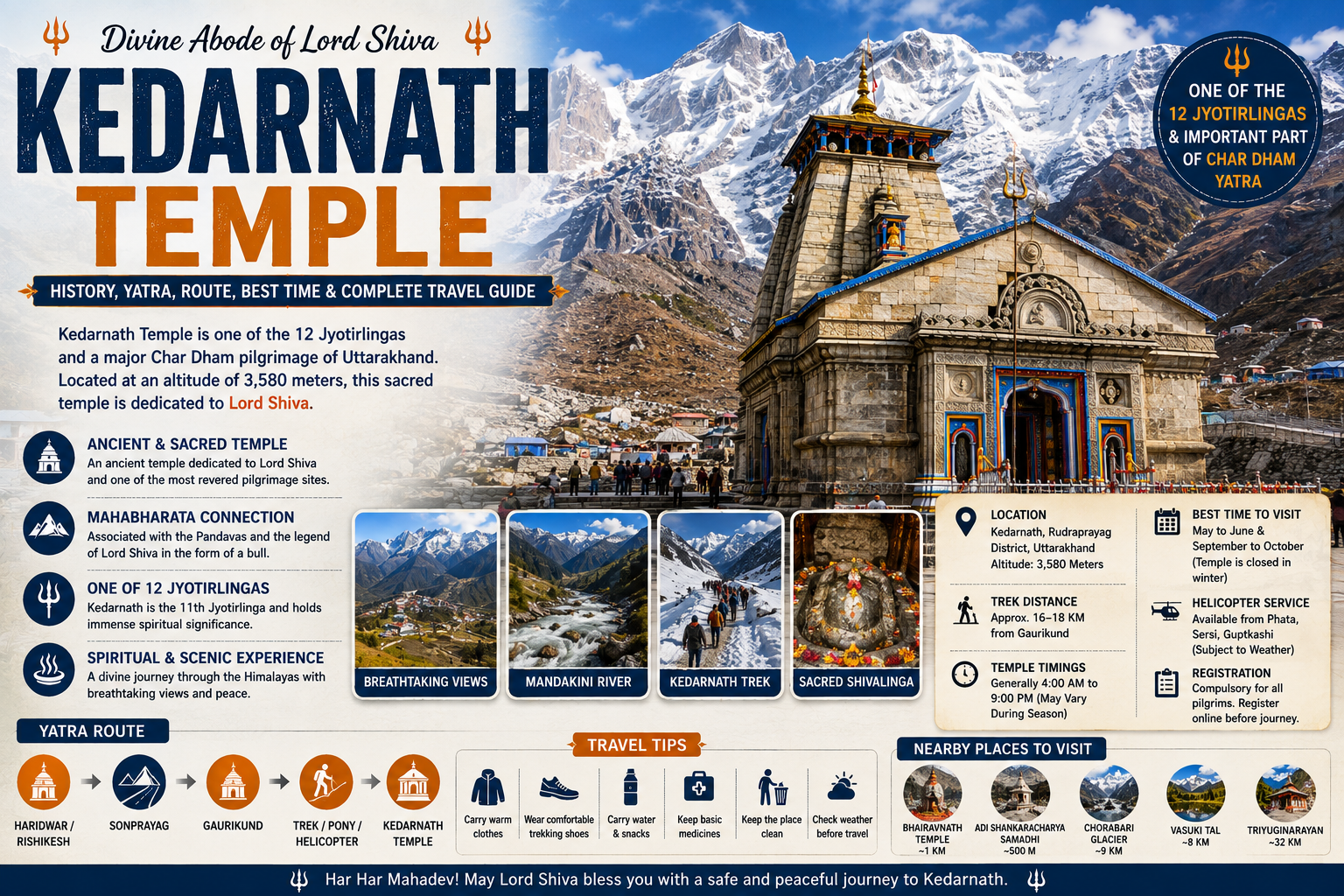
Kedarnath Temple – Uttarakhand
Located high in the Himalayas, Kedarnath Temple is one of the most important Shiva pilgrimage destinations and one of the 12 Jyotirlingas.
The temple is also an important part of the Char Dham pilgrimage of Uttarakhand.
Kashi Vishwanath Temple – Varanasi
Located in the sacred city of Varanasi, Kashi Vishwanath is one of India's most revered Shiva temples.
The temple is associated with the Jyotirlinga tradition and is situated near the holy Ganga.
Somnath Temple – Gujarat
Somnath is one of the most famous Shiva temples in India and is traditionally regarded as the first among the 12 Jyotirlingas.
Its location beside the Arabian Sea makes it particularly spectacular.
Mahakaleshwar Temple – Ujjain
Located in Madhya Pradesh, Mahakaleshwar is one of the 12 Jyotirlingas.
The temple is especially famous for its Bhasma Aarti, an important daily religious ceremony.
Trimbakeshwar Temple – Maharashtra
Located near Nashik, Trimbakeshwar is another important Jyotirlinga temple.
The temple is also closely associated with the origin of the Godavari River.
Lingaraj Temple – Bhubaneswar
Lingaraj Temple is one of the most important historic temples in Odisha and is dedicated to Shiva in the form of Harihara.
Its magnificent Kalinga-style architecture makes it an important cultural attraction.
Brihadeeswarar Temple – Tamil Nadu
The Brihadeeswarar Temple at Thanjavur is one of India's great architectural achievements.
Although primarily associated with Shiva, the temple is also an important UNESCO World Heritage cultural site as part of the Great Living Chola Temples.
Maha Shivratri
Maha Shivratri is one of the most important festivals dedicated to Lord Shiva.
Devotees across India observe fasting, prayers, meditation and night-long worship.
Major Shiva temples can become especially busy during Maha Shivratri.
The festival is associated with:
- Devotion to Shiva
- Fasting
- Meditation
- Temple visits
- Shivling worship
- Night-long prayers
Sawan and Lord Shiva
The month of Shravan, commonly known as Sawan, is particularly important for Shiva devotees.
During this period, devotees often visit Shiva temples and offer water and other traditional offerings to the Shivling.
The Kanwar Yatra is another major pilgrimage tradition during the Sawan period, with devotees travelling to collect sacred Ganga water and offer it at Shiva temples.
Why Visit Shiva Temples in India?
A journey to a Shiva temple can offer much more than sightseeing.
🛕 Spiritual Experience
Experience centuries-old traditions and religious practices.
📖 Cultural Heritage
Discover India's mythology, architecture and local customs.
🏔️ Beautiful Destinations
Many famous Shiva temples are located in spectacular landscapes.
🧘 Peace & Meditation
Temples can provide a peaceful environment for reflection.
📸 Architecture
Many Shiva temples are masterpieces of Indian architecture.
Best Shiva Temples for Spiritual Travel
If you want to plan a Shiva-focused trip, consider these destinations:
| Destination | Famous Shiva Temple | State |
|---|---|---|
| Kedarnath | Kedarnath Temple | Uttarakhand |
| Varanasi | Kashi Vishwanath | Uttar Pradesh |
| Ujjain | Mahakaleshwar | Madhya Pradesh |
| Somnath | Somnath Temple | Gujarat |
| Nashik | Trimbakeshwar | Maharashtra |
| Rameswaram | Ramanathaswamy Temple | Tamil Nadu |
| Bhubaneswar | Lingaraj Temple | Odisha |
Best Time for a Shiva Temple Tour
The best time depends on the temple and destination.
For Himalayan temples such as Kedarnath, the pilgrimage season is limited because of winter weather.
For temples in cities and plains, travel is generally possible throughout the year.
Maha Shivratri and Sawan are particularly significant periods for devotees, but these can also be among the busiest times.
Tips for Visiting Shiva Temples
Before visiting a Shiva temple, keep these tips in mind:
- Dress respectfully.
- Follow temple rules.
- Check opening and closing timings.
- Follow photography restrictions.
- Avoid carrying prohibited items.
- Respect local traditions.
- Keep the temple premises clean.
- During major festivals, expect large crowds.
- For high-altitude temples, check weather conditions before travelling.
- Verify current registration requirements for pilgrimage destinations.
Lord Shiva and Travel in India
A Shiva pilgrimage can take you across some of India's most beautiful landscapes.
From the Himalayan peaks of Kedarnath to the Ganga ghats of Varanasi, the coastal landscape of Somnath and the historic streets of Ujjain, Shiva temples connect spirituality with India's incredible cultural diversity.
For travellers interested in history, religion, architecture and nature, a Shiva temple tour can become an unforgettable journey.
TravelOChat Special: Explore the World of Mahadev
India's Shiva temples tell stories that go back through generations.
Whether you want to experience the spiritual atmosphere of Kedarnath, explore ancient Varanasi, witness the grandeur of Somnath or discover the heritage of South Indian Shiva temples, every destination offers a different experience.
Plan your spiritual journey with TravelOChat and explore India's remarkable temples, traditions and destinations.
Travel with faith. Discover India's heritage. Experience the journey of Mahadev.
Final Words
Lord Shiva is one of the most revered deities in Hinduism and an important part of India's spiritual and cultural heritage.
From the sacred Jyotirlingas to ancient temples, Himalayan pilgrimage routes and grand festivals such as Maha Shivratri, the traditions associated with Shiva continue to inspire millions of devotees.
A journey to the famous Shiva temples of India offers an opportunity to experience not only spirituality but also the country's extraordinary history, architecture, landscapes and cultural traditions.
Har Har Mahadev! 🕉️🔱
Written by TraveloChat Editorial
Senior Destination Specialist at TraveloChat Desk. Expert in itinerary planning, B2B hotel contracts, and international visa concierge.Inspired to Visit Domestic Destinations?
Get a 100% customized tour package with direct B2B transparent pricing and 24/7 on-tour support.